
-
CityLand – Vol. 3, No. 11
Center for New York City Law
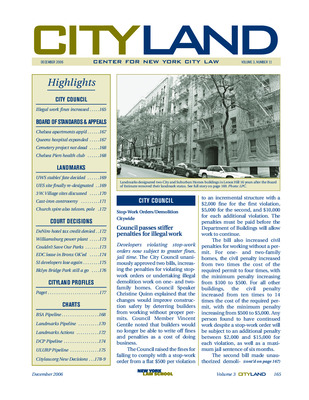
The December 2006 issue of CityLand covers major land use, preservation, and legal developments across New York City. The City Council passed legislation increasing penalties for illegal construction and unauthorized demolition. BSA approved variances for residential and hospital developments in Chelsea and Queens, and a mixed-use project on a former cemetery site in Corona. Landmarks designated the New York Cab Company Stable but declined to landmark the Dakota Stables due to preemptive alterations. The Commission re-designated two City and Suburban Homes buildings in Lenox Hill, reversing a 1990 Board of Estimate decision. Hearings were held on three Far West Village buildings and a cast-iron building at 63 Nassau Street. Legal updates included the denial of brownfield tax credits for Robert DeNiro’s Tribeca hotel, a court ruling against TransGas Energy’s condemnation attempt in Williamsburg, and the rejection of a challenge to the Yankee Stadium redevelopment. The Brooklyn Bridge Park plan withstood legal scrutiny over its inclusion of private residential development. A profile of environmental attorney David Paget explored the evolution of environmental impact statements and their role in shaping major city projects. Pipeline charts track ULURP certifications, BSA applications, and landmark actions.
-
CityLand – Vol. 3, No. 10
Center for New York City Law
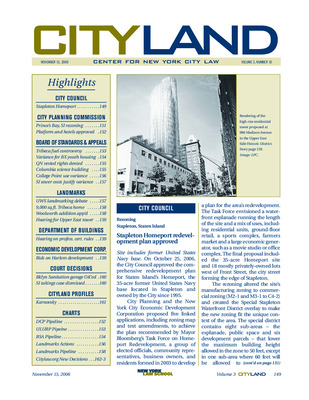
The November 2006 issue of CityLand covers significant land use, preservation, and development actions across New York City. The City Council approved the redevelopment plan for Stapleton Homeport in Staten Island, transforming a former Navy base into a mixed-use waterfront district. The Planning Commission approved rezoning in Prince’s Bay and special permits for hotel development over Amtrak rail lines in Clinton. BSA decisions included a variance for youth housing in the Bronx, denial of vested rights in Queens, and approval of Columbia University’s science building. Landmark actions included hearings on the Dakota and New York Cab Company stables in the Upper West Side, a controversial Norman Foster-designed tower at 980 Madison Avenue, and approvals for a private residence in Tribeca and rooftop additions to the Woolworth Building. The Department of Buildings held a hearing on proposed rule changes to tighten professional certification standards. The Economic Development Corporation reissued an RFP for a six-acre Harlem site after community opposition to the original plan. Legal updates covered court decisions on a sanitation garage in Clinton Hill and a takings claim in Staten Island. A profile of City Planning’s General Counsel David Karnovsky explored emerging planning issues, including Broadway air rights, community board planning tools, and waterfront esplanade implementation. Pipeline charts track ULURP certifications, BSA applications, and landmark actions.
-
CityLand – Vol. 3, No. 9
Center for New York City Law
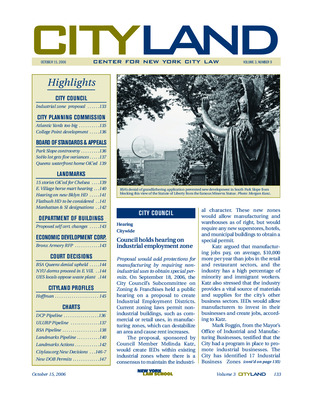
The October 2006 issue of CityLand highlights major land use, preservation, and development actions across New York City. The City Council held hearings on a proposal to create Industrial Employment Districts to protect manufacturing zones. The Planning Commission recommended an eight percent reduction in Forest City Ratner’s Atlantic Yards project and approved development in College Point after resolving landfill issues. BSA denied a grandfathering application in South Park Slope and approved variances for a SoHo development and a waterfront home in Douglaston. Landmark actions included approval of a 15-story building in the Ladies’ Mile Historic District, an emergency hearing on the Van Tassel Horse Mart, and hearings on proposed historic districts in Crown Heights and Flatbush. The Morse Building and Staten Island Savings Bank were designated as individual landmarks. The Department of Buildings proposed rule changes to expand grounds for suspending architects and engineers from the self-certification program. The Economic Development Corporation issued an RFP for the redevelopment of the Kingsbridge Armory. Legal updates covered court decisions on a Queens homeless housing expansion, NYU’s East Village dormitory, and a waste transfer station on East 91st Street. A profile of Earth Pledge Executive Director Leslie Hoffman explored green roof initiatives and sustainable design in New York City. Pipeline charts track ULURP certifications, BSA applications, and landmark actions.
-
CityLand – Vol. 3, No. 8
Center for New York City Law
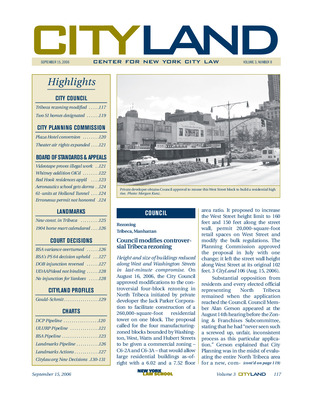
The September 2006 issue of CityLand covers major land use and preservation developments across New York City. The City Council approved a modified rezoning in North Tribeca, reducing building height and floor area in response to community opposition. Landmark designations for two Staten Island homes were approved despite owner objections. The Planning Commission approved a special permit for retail use at the Plaza Hotel and expanded air rights for the Hirschfeld Theatre. BSA decisions included denial of a permit for illegal demolition in Park Slope, approval of variances for the Whitney Museum expansion, residential use in Red Hook, a dormitory for Vaughn College, and apartments near the Holland Tunnel. A variance request in Holliswood was denied due to lack of hardship. Landmark permits were issued for new construction in Tribeca and SoHo, and the Van Tassel Horse Mart was calendared for designation. Legal updates included a court overturning a BSA variance in Staten Island, upholding BSA’s decision on P.S. 64, reversing a DOB injunction, and ruling that UDAAP deed restrictions do not bind future owners. A court denied an injunction to halt Yankees Stadium construction. A profile of DOT Assistant Commissioner Kerry Gould-Schmit highlighted the billion-dollar street furniture franchise. Pipeline charts track ULURP certifications, BSA applications, and landmark actions.
-
CityLand – Vol. 3, No. 7
Center for New York City Law
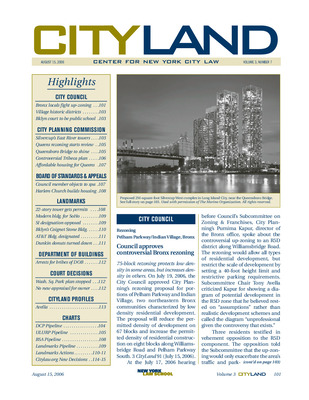
The August 2006 issue of CityLand covers significant land use and preservation developments across New York City. The City Council approved a controversial rezoning in Pelham Parkway and Indian Village, Bronx, and finalized designations for two West Village historic districts. The School Construction Authority received approval to convert the former Brooklyn Family Court into a high school. The Planning Commission approved Silvercup Studios’ 2-million-square-foot mixed-use development in Long Island City, and certified a downzoning proposal for Douglaston/Little Neck. A private developer’s rezoning in North Tribeca was approved despite opposition. The Commission also extended the inclusionary housing program to Queens for the first time. BSA decisions included a special permit for Spa World in College Point and a variance for a Harlem church’s residential project. Landmark actions included designations for the AT&T Building and lobby, the Coignet Stone Company Building in Gowanus, and hearings on the Thompson House in Staten Island. The Department of Investigation arrested several individuals for bribery and forgery involving DOB. Legal updates covered a court injunction halting renovations to Washington Square Park and a denied motion to revise an appraisal in an eminent domain case. A profile of Council Member Tony Avella highlighted his land use reform initiatives, including BSA oversight, architectural review boards, and stricter enforcement of illegal construction. Pipeline charts track ULURP certifications, BSA applications, and landmark actions.
-
CityLand – Vol. 3, No. 6
Center for New York City Law
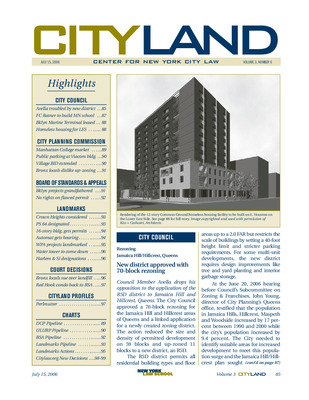
The July 2006 issue of CityLand covers major land use and preservation developments across New York City. The City Council approved a 70-block rezoning in Jamaica Hill and Hillcrest, Queens, including the creation of a new R5D zoning district. Forest City Ratner’s 75-story development in Lower Manhattan will include a public school. The Council also approved a lease for the South Brooklyn Marine Terminal and a 12-story homeless housing facility on East Houston Street. The Planning Commission approved a rezoning and pedestrian bridge for Manhattan College’s parking garage and supermarket project, and a special permit for public parking at the Viacom Building in Times Square. The Village Alliance BID was expanded, and a rezoning in Pelham Parkway/Indian Village was sent to Council. BSA decisions included vested rights approvals for South Park Slope developments and a denial for a flawed permit in Briarwood. Landmark actions included the designation of P.S. 64, WPA-era civic projects (Astoria Play Center, Orchard Beach Bathhouse), a firehouse, an automat, and historic buildings in Harlem and Staten Island. Legal updates covered a cancer lawsuit linked to the Pelham Bay landfill and a court remand of a Red Hook condo variance. A profile of new Landmarks Commissioner Margery H. Perlmutter explored her background and controversial confirmation. Pipeline charts track ULURP certifications, BSA applications, and landmark actions.
-
CityLand – Vol. 3, No. 5
Center for New York City Law
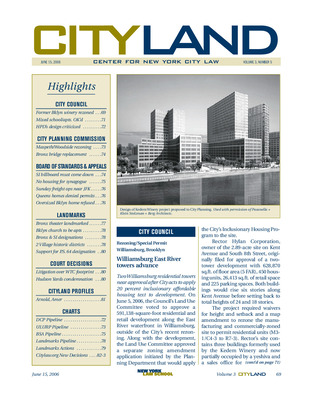
The June 2006 issue of CityLand highlights significant land use, preservation, and development actions across New York City. The City Council approved a two-tower residential development on the Williamsburg waterfront and applied the Inclusionary Housing Program to the site. A mixed-use development combining a public school and residential tower was approved on the Upper East Side, facilitated by amendments to the Educational Construction Fund zoning provisions. The Planning Commission approved a 134-block rezoning in Maspeth and Woodside, Queens, and the construction of a new Willis Avenue Bridge over the Harlem River. BSA decisions included variances for a Williamsburg synagogue, a freight facility near JFK, and a denied permit for an oversized home in Manhattan Beach. Landmark actions included the designation of the Loew’s Paradise Theater interior in the Bronx, the Estey Piano Factory, the DeHart House in Staten Island, and two new historic districts in the West Village. The conversion of a Cobble Hill church into residences was also approved. Legal updates covered litigation over the World Trade Center memorial footprint and a challenge to Hudson Yards condemnation. A profile of DOB’s General Counsel and Deputy Commissioner discussed the city’s efforts to adopt a revised model building code. Pipeline charts track ULURP certifications, BSA applications, and landmark actions.
-
CityLand – Vol. 3, No. 4
Center for New York City Law
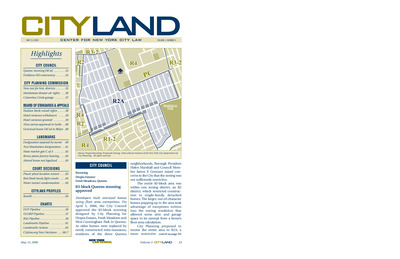
The May 2006 issue of CityLand highlights significant land use and preservation developments across New York City. The City Council approved the rezoning of 83 blocks in Utopia Estates and Fresh Meadows, Queens, to curb oversized home construction. The Council also approved the designation of the Fieldston Historic District in the Bronx, rejecting allegations of discrimination. The Planning Commission approved a text amendment and special permits for a mixed-use development at 311 West Broadway in SoHo, and certified applications for air rights transfers from the Al Hirschfeld Theatre and multiple parking garages in the Columbus Circle area. BSA decisions included vested rights for a Hudson Yards site, variances for hotels in Ditmas Park and SoHo, and legalization of an oversized home in Midwood. Landmark actions included designation of 2 Park Avenue and the Stewart & Company Building, a hearing for the Estey Piano Factory in the Bronx, and approval of a redesigned Western Beef building in the West Village. Legal updates covered challenges to power plant siting in Williamsburg, a Red Hook condo variance, and condemnation procedures for the Third Water Tunnel. The issue also introduced CityLand Profiles, featuring Manhattan Borough President Scott Stringer’s land use agenda.
-
CityLand – Vol. 3, No. 3
Center for New York City Law
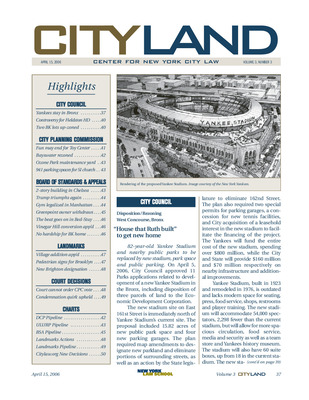
The April 2006 issue of CityLand centers on the City Council’s approval of the new Yankee Stadium project in the Bronx, which includes a new stadium, 15.82 acres of new parkland, four parking garages, and a Yankees museum. The Council also held a hearing on the controversial designation of the Fieldston Historic District in the Bronx and approved a modified upzoning for two lots in East Windsor Terrace, Brooklyn. The Planning Commission approved the conversion of the Toy Center in Chelsea to residential use, a rezoning of 82 blocks in Bayswater and Far Rockaway, and a new DOT maintenance yard in Ozone Park. Staten Island saw approval of a 941-space parking lot for Gateway Cathedral. BSA decisions included variances for a 12-story building in Chelsea, legalization of the Equinox gym on Third Avenue, and a residential conversion in Vinegar Hill. Other BSA actions addressed music studio use in Bedford-Stuyvesant, a withdrawn Greenpoint application, and a denied variance for a Sheepshead Bay home. Landmark actions included approval of a three-story rear addition in Greenwich Village, directional signage in Brooklyn historic districts, and designation of 1 Pendleton Place in Staten Island. Court decisions covered the City Planning Commission’s authority to manage its calendar, condemnation procedures, and challenges to landmark designations. Pipeline charts track ULURP certifications, BSA applications, and landmark actions.
-
CityLand – Vol. 3, No. 2
Center for New York City Law
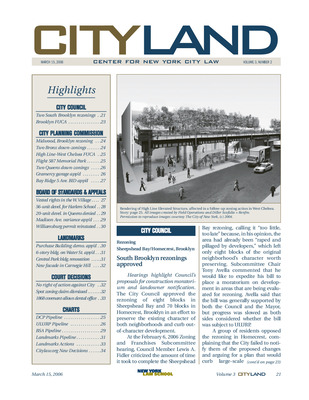
The March 2006 issue of CityLand covers a wide range of land use and preservation developments across New York City. The City Council approved rezonings in Sheepshead Bay and Homecrest, Brooklyn, and adopted follow-up corrective actions (FUCAs) for the Greenpoint-Williamsburg rezoning. The Planning Commission approved rezonings in Midwood, Pelham Bay, Westchester Square, and Middle Village/Glendale, as well as modifications to the High Line/West Chelsea district and the establishment of Flight 587 Memorial Park in Far Rockaway. A special permit for a parking garage in Gramercy was approved despite opposition from new Manhattan Borough President Scott Stringer. The Bay Ridge 5th Avenue BID was also approved. BSA decisions included vested rights approvals for developments in the Far West Village, variances for a Harlem school conversion, and a Madison Avenue office building. Landmark actions included approval for demolition of the Purchase Building in Brooklyn’s Fulton Ferry Historic District to make way for Brooklyn Bridge Park, a new six-story building in South Street Seaport, and renovations to Central Park’s Rumsey Summer Stage Support Building. Legal updates addressed spot zoning claims, private rights under federal law, and restrictive covenants. Pipeline charts track ULURP certifications, BSA applications, and landmark actions.
-
CityLand – Vol. 3, No. 1
Center for New York City Law
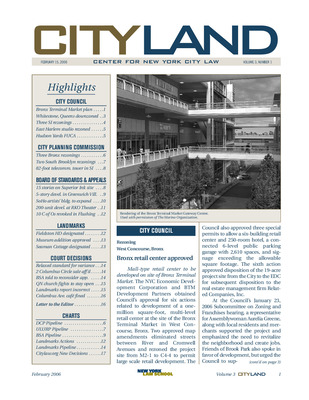
The February 2006 issue of CityLand highlights major land use and preservation developments across New York City. The City Council approved the redevelopment of the Bronx Terminal Market into a one-million-square-foot retail center and down-zoned 311 blocks in Whitestone, Queens. Staten Island saw three commercial rezonings and a text amendment to restrict residential-only development in commercial districts. The Council also approved zoning changes for Metropolis Studios in East Harlem and adopted 17 corrective amendments to the Hudson Yards revitalization plan. The Planning Commission approved rezonings in Baychester, Woodlawn, Ferry Point, Sheepshead Bay, and Homecrest. BSA decisions included variances for a 15-story development at the Superior Ink site, a five-story building in Greenwich Village, and a 200-unit mixed-use development at the RKO Keith Theater site in Flushing. Landmark actions included the designation of the Fieldston Historic District in the Bronx, the Seaman Cottage in Staten Island, and approval of a two-story addition to the Museum of the City of New York. Legal updates covered relaxed standards for area variances, the affirmed sale of Two Columbus Circle, and a court order for LPC to reevaluate a designation report. Pipeline charts track ULURP certifications, BSA applications, and landmark actions.
Printing is not supported at the primary Gallery Thumbnail page. Please first navigate to a specific Image before printing.