
-
CityLand – Vol. 4, No. 11
Center for New York City Law
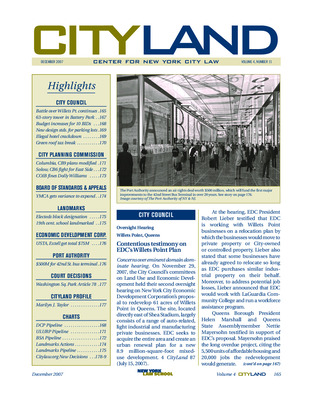
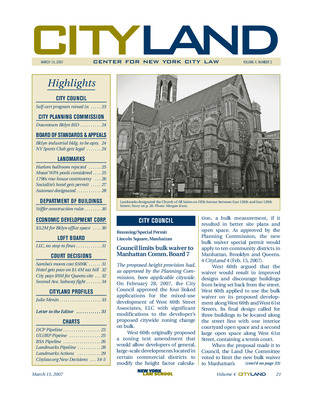
The December 2007 issue of CityLand covers major land use and development initiatives across New York City. It features contentious hearings on the redevelopment of Willets Point, the approval of a 63-story tower at 50 West Street using Battery Tunnel air rights, and the Planning Commission’s modifications to Columbia University’s Manhattanville expansion and Community Board 9’s 197-a plan. The issue also highlights new zoning standards for parking lots, a proposed crackdown on illegal hotel conversions, and a green roof tax incentive resolution. Landmark actions include the designation of the 19th-century P.S. 90 school in Brooklyn and the removal of the Mariners’ Family Asylum from the designation calendar. The Port Authority announces a $500 million air rights deal to fund improvements to the 42nd Street Bus Terminal. The issue concludes with a court decision allowing renovations to Washington Square Park and a profile of urban planner Marilyn J. Taylor.
-
CityLand – Vol. 4, No. 10
Center for New York City Law
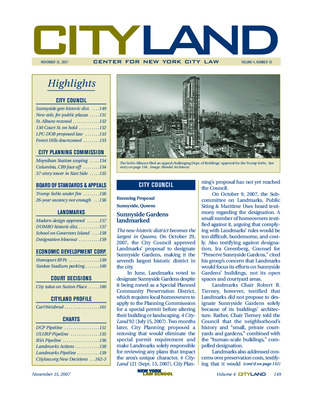
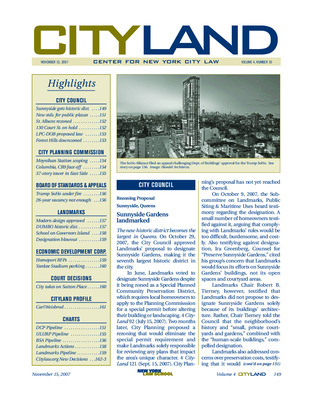
This issue of CityLand covers significant land use and zoning developments in New York City as of November 15, 2007. Highlights include the designation of Sunnyside Gardens as a historic district, updates to public plaza design standards, and rezoning efforts in Forest Hills, St. Albans, and Hollis. The issue also reports on the Moynihan Station redevelopment, Columbia University's expansion plans in Manhattanville, and legal challenges surrounding the Trump SoHo development. Landmark designations, including the Lord & Taylor Building and the Eberhard Faber Pencil Company complex, are featured alongside summaries of ULURP and BSA pipeline applications. The issue concludes with a profile of Carl Weisbrod and his impact on urban revitalization.
-
CityLand – Vol. 4, No. 9
Center for New York City Law
The October 2007 issue of CityLand covers major land use, preservation, and development actions across New York City. The City Council approved DEP’s expansion of the Hunts Point water treatment plant, despite concerns over odor and air quality. The Upper West Side rezoning plan was modified to accommodate Jewish Home & Hospital, with restrictions negotiated by Council Member Katz. The Planning Commission approved the Bedford-Stuyvesant rezoning, the Trader Joe’s development in Cobble Hill, and a 57-story mixed-use tower at 400 Fifth Avenue. Amendments to the High Line zoning text allowed the City to build amenities in exchange for developer fees. Fordham University’s Lincoln Square campus expansion began environmental review. BSA ruled against DOB’s interpretation of the Sliver Law and approved variances for residential conversions and affordable housing projects. Landmarks designated the Domino Sugar Refinery and approved new buildings for the General Theological Seminary. Hearings were held for P.S. 90 in Flatbush and the Voelker-Orth Museum in Flushing. EDC issued an RFP for a mixed-use development in Jamaica and applied for $11.2 million in state funds for projects in Harlem and Jamaica. A court dismissed Stuy Town tenants’ claims regarding J-51 tax benefits. A profile of Pat Jones highlighted her leadership in Community Board 9 and her advocacy for the Manhattanville 197-a plan.
-
CityLand – Vol. 4, No. 8
Center for New York City Law
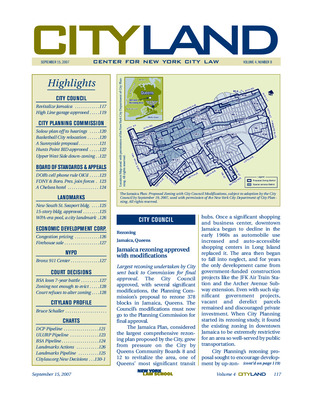
The September 2007 issue of CityLand covers major land use, preservation, and development actions across New York City. The City Council approved the Jamaica rezoning plan with modifications, including changes to Hillside Avenue and manufacturing zones near the LIRR. Related Companies received approval for a 210-space garage at its High Line-adjacent luxury development. Solow Properties’ massive East Side redevelopment plan began public review. Basketball City was approved to relocate to Pier 36. City Planning proposed a zoning text amendment to make Landmarks the sole permitting authority for Sunnyside Gardens. The Commission approved a new BID for Hunts Point and a 51-block rezoning for the Upper West Side. BSA upheld DOB’s authority to permit rooftop cell phone antennas and approved a controversial Staten Island health care facility. It also granted variances for the conversion of the Maritime Union building into a hotel. Landmarks approved new buildings in the South Street Seaport and Ladies’ Mile districts and designated the WPA-era Highbridge Pool. EDC issued RFPs for congestion pricing implementation and redevelopment of two former Brooklyn firehouses. NYPD held a hearing on a proposed 911 dispatch center in the Bronx. Court decisions included a reversal of BSA’s denial of a variance, a tenant victory in a Williamsburg eviction case, and a rejection of a challenge to a Brooklyn rezoning. A profile of Bruce Schaller, DOT’s Deputy Commissioner, explored his role in advancing congestion pricing.
-
CityLand – Vol. 4, No. 7
Center for New York City Law
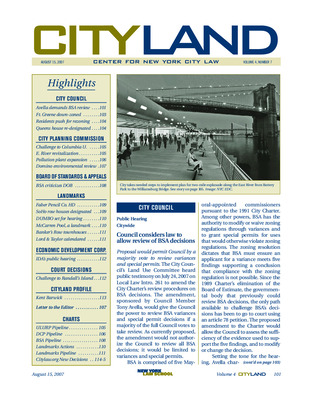
The August 2007 issue of CityLand covers major land use, preservation, and development actions across New York City. The City Council held a hearing on a proposed Charter amendment to allow Council review of BSA decisions. Rezoning plans were approved for Fort Greene/Clinton Hill and Dyker Heights/Fort Hamilton, and a home in Douglaston was re-designated after a court voided its inclusion. Competing redevelopment plans for Manhattanville were submitted by Columbia University and Tuck-It-Away Storage. The Planning Commission approved the East River Esplanade plan and the expansion of the Hunts Point pollution plant. A public hearing was held on the environmental scope for the Domino Sugar Refinery redevelopment. BSA heard disputes over the Sliver Law and was criticized for its interpretation. Landmarks designated McCarren Pool, two SoHo row houses, and townhouses on East 56th Street, and calendared the DUMBO Historic District and Lord & Taylor’s Fifth Avenue building. The Eberhard Faber Pencil Company Historic District was heard. A court challenge to the Randall’s Island concession agreement was filed, alleging the City bypassed ULURP. A profile of Kent Barwick, President of the Municipal Art Society, reflected on his career in preservation and advocacy.
-
CityLand – Vol. 4, No. 6
Center for New York City Law
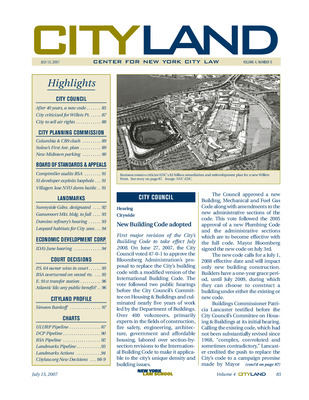
The July 2007 issue of CityLand covers major land use, preservation, and development actions across New York City. The City Council adopted a new Building Code, the first major revision since 1968, to take effect in July 2008. A joint oversight hearing examined EDC’s $3 billion redevelopment plan for Willets Point, raising concerns over displacement and eminent domain. The Council approved the sale of air rights from a City-owned site in Downtown Brooklyn to facilitate a residential tower. Columbia University and Community Board 9 submitted competing development plans for Manhattanville. Solow Properties filed applications for a major redevelopment of the former Con Edison site. BSA decisions included a denial of a challenge to NYU’s East Village dormitory, a reversal of DOB’s permit denial in Staten Island, and a ruling against a developer in Queens on vested rights. Landmarks designated Sunnyside Gardens as a historic district and held a hearing on the Domino Sugar Refinery. New leopard habitats were approved for Central Park and Prospect Park Zoos. Court decisions addressed the legality of the Atlantic Yards project, the East 91st Street transfer station, and the P.S. 64 dormitory permit. A profile of Simeon Bankoff, Executive Director of the Historic Districts Council, explored his advocacy for preservation and reform of the Landmarks process.
-
CityLand – Vol. 4, No. 5
Center for New York City Law
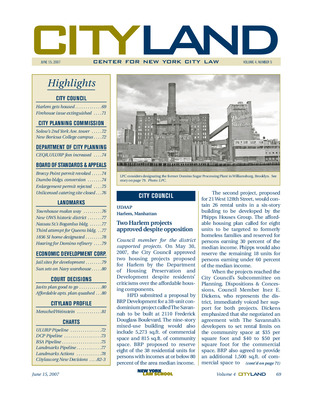
The June 2007 issue of CityLand covers major land use, preservation, and development actions across New York City. The City Council approved two affordable housing projects in Harlem despite community opposition and added restrictions to the sale of four former firehouses, limiting them to community use. Solow Management’s proposed 37-story tower on York Avenue entered public review, and HPD’s Boricua Village proposal for a large mixed-use development in Melrose, Bronx was approved. City Planning increased CEQR and ULURP fees. BSA dismissed a contentious Breezy Point appeal and approved a Dumbo residential conversion. A catering hall in Boro Park was ordered closed, and a Manhattan Beach enlargement permit was rejected. Landmarks designated the Manhattan Avenue Historic District, 63 Nassau Street (a Bogardus cast-iron building), the Sohmer Piano Factory, and the Wyeth House in Staten Island. A hearing was held for the Domino Sugar Plant in Williamsburg. EDC issued RFPs for redevelopment of jail-adjacent sites in Downtown Brooklyn and selected developers for a Navy warehouse conversion in Sunset Park. Court decisions upheld the Javits Center expansion and struck down a local law aimed at preserving affordable housing. A profile of Ronay Menschel and Adam Weinstein of Phipps Houses explored their leadership in affordable housing development.
-
CityLand – Vol. 4, No. 3
Center for New York City Law
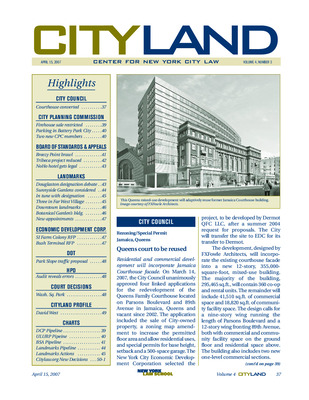
The April 2007 issue of CityLand covers major land use, preservation, and development actions across New York City. The City Council approved redevelopment of the former Jamaica Courthouse into a mixed-use building incorporating the historic facade. The Planning Commission approved the sale of a former firehouse with a restriction for community use and a 369-space garage in Battery Park City. BSA decisions included a contentious appeal over a Breezy Point home, variances for residential buildings in Tribeca, and legalization of a NoHo hotel. Landmarks held a new hearing on re-inclusion of a Douglaston home into a historic district and calendared Sunnyside Gardens for designation. The Sohmer Piano Factory in Queens and three Far West Village buildings were designated. Additional designations included two Park Place buildings and the Brooklyn Botanical Garden’s Laboratory Administration Building. EDC issued RFPs for redevelopment of the Staten Island Farm Colony and Bush Terminal in Brooklyn. DOT proposed traffic changes in Park Slope. HPD was criticized in a Comptroller audit of the J-51 tax incentive program. The courts ruled on Washington Square Park renovations, a $9M valuation for a Queens condemnation, and a Second Avenue Subway condemnation challenge. A profile of architect David West explored his zoning expertise and work on high-profile projects like 443 Greenwich Street.
-
CityLand – Vol. 4, No. 2
Center for New York City Law
The March 2007 issue of CityLand covers significant land use, preservation, and development actions across New York City. The City Council approved a modified bulk waiver for West 60th Street Associates’ mixed-use development, limiting its applicability to Manhattan Community Board 7. Council also passed amendments to the Department of Buildings’ self-certification program, tightening rules and enforcement. The Planning Commission approved the creation of the Court Livingston Schermerhorn BID in Downtown Brooklyn. BSA decisions included a variance for residential conversion in Carroll Gardens and legalization of a New York Sports Club in SoHo. Landmarks rejected designation of the Renaissance Ballroom in Harlem, citing community opposition, and held hearings on nine WPA-era pools built under Robert Moses. Hearings were also held on three Federal-style row houses on Greenwich Street, with ownership disputes complicating the landmarking process. A four-story addition to the Lambs Club was approved, and the Horn & Hardart Automat building was designated. Two Harlem churches—St. Aloysius and All Saints—were also designated. The Department of Buildings proposed stricter rules for construction superintendents. EDC’s IDA awarded $3.2 million in tax exemptions for a major mixed-use development in Downtown Brooklyn. Legal updates included a $500K fine for Sushi Samba’s illegal roof structure, a $9M valuation for a condemned Queens waterfront site, and a successful challenge to a $1.4M transfer tax bill by Regal Hotels. A profile of Julie Menin, Chair of Manhattan Community Board 1, explored proactive planning efforts in Lower Manhattan.
-
CityLand – Vol. 4, No. 1
Center for New York City Law
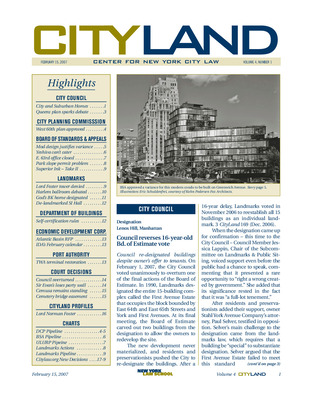
The February 2007 issue of CityLand covers major land use, preservation, and development actions across New York City. The City Council re-designated the First Avenue Estate buildings in Lenox Hill, reversing a 1990 Board of Estimate decision. A controversial rezoning in Douglaston and Little Neck was modified and approved. The Planning Commission approved a rezoning and special permits for a mixed-use development near Lincoln Center, including a new bulk waiver affecting ten community districts. BSA decisions included variances for a modern condo on Greenwich Avenue, denial of a catering hall in a Brooklyn yeshiva, and refusal to grandfather Park Slope condos built on invalid permits. A revised plan for the Superior Ink site was approved, and Landmarks rejected Lord Norman Foster’s proposed tower addition to 980 Madison Avenue. Hearings were held on the Renaissance Ballroom in Harlem and the Elwell House in Clinton Hill, which was designated amid demolition concerns. Landmarks rescinded the designation of the New Brighton Village Hall in Staten Island after its demolition. The Department of Buildings adopted expanded self-certification rules. EDC issued an RFP for the Atlantic Basin Marina in Red Hook and announced $811 million in bond offerings. The Port Authority sought proposals for restoration of the landmarked TWA terminal at JFK. Legal updates included court decisions on a Brooklyn rezoning, a party wall dispute in Midtown, a street furniture franchise challenge, and a bridge easement in Cypress Hills Cemetery. A profile of Lord Norman Foster explored his architectural philosophy and experiences with New York’s approval processes.
Printing is not supported at the primary Gallery Thumbnail page. Please first navigate to a specific Image before printing.