
-
CityLand – Vol. 8, No. 11
Center for New York City Law
This issue of CityLand covers key land use and policy developments in New York City as of December 2011. The City Council debated an amended version of the Fair Wages for New Yorkers Act, narrowing its scope and duration. The Council approved the creation of the Special 4th Avenue Enhanced Commercial District in Brooklyn and the Admirals Row Plaza project at the Brooklyn Navy Yard, which includes retail, manufacturing, and historic preservation components. New local laws were enacted to formalize public consultation and reporting requirements for Department of Transportation street projects. The City Planning Commission approved the Borough Hall Skyscraper Historic District and held a public hearing on Rudin Management’s redevelopment proposal for the former St. Vincent’s Hospital site in the West Village. The Board of Standards & Appeals denied a challenge to a mosque’s parking waiver in Sheepshead Bay. Landmarks approved a revised six-story building in NoHo and rejected a ten-story rooftop addition on the Upper East Side. Other approvals included a reduced rooftop and rear addition in NoHo and a nine-story residential building in Tribeca. The Economic Development Corporation issued an RFEI for maritime industrial use on a 33-acre waterfront site in Rossville, Staten Island. Administrative decisions included a $10,000 fine for former Bronx Borough President Adolfo Carrión Jr. and enforcement of building code parapet height requirements. A court granted Landmarks a preliminary injunction to remove illegal advertising signs from a building in SoHo. A profile of BSA Commissioner Susan M. Hinkson highlights her architectural and legal career and her role in shaping land use decisions.
-
CityLand – Vol. 8, No. 10
Center for New York City Law
This issue of CityLand covers significant land use and zoning developments in New York City as of November 15, 2011. The City Council approved street-grade changes in Coney Island to improve flood resilience and pedestrian access, and reviewed the creation of the Westchester Square Business Improvement District in the Bronx. The City Planning Commission approved the Admirals Row Plaza project at the Brooklyn Navy Yard, which includes a supermarket and industrial space, and granted a special permit for a private K–12 school in West Chelsea. A new Special 4th Avenue Enhanced Commercial District was established in Park Slope to promote active ground-floor uses and transparency. The Commission also increased the contribution rate to the Theater Subdistrict Fund. Landmark designations included the Grand Concourse Historic District in the Bronx, Westbeth Artists’ Housing in Manhattan, and St. Casimir’s Church in Fort Greene. Landmarks also reviewed a redevelopment proposal adjacent to the Whitney Museum and a rooftop addition in NoHo. Court decisions addressed challenges to a Chelsea homeless shelter and valuation disputes in the Hudson Yards eminent domain proceedings. A profile of land use attorney Jesse Masyr explores his career and insights into development, community engagement, and the ULURP process.
-
CityLand – Vol. 8, No. 9
Center for New York City Law
This issue of CityLand highlights significant land use and zoning developments in New York City as of October 15, 2011. The City Council approved Signature Urban Properties’ ten-building, 1,300-unit mixed-use development in Crotona Park East, Bronx, and a 181-block contextual rezoning in Williamsbridge and Baychester. The Council rejected the landmark designation of the Hardenbrook-Somarindyck House at 135 Bowery, citing economic development concerns. The Gravesend Bay shopping center proposal was approved, featuring a BJ’s Wholesale Club and waterfront esplanade. The Council also established the Chinatown BID after extensive public debate and created the new M1-6D zoning district to support mixed-use development in Midtown. The Boerum Hill rezoning was adopted to preserve neighborhood scale. Landmark designations included the Madison Belmont Building and its Art Deco lobby, and the Borough Hall Skyscraper Historic District in Brooklyn. The Puck Building rooftop additions were reviewed but not approved. Court decisions upheld the Sunset Park rezoning and reversed a $40,000 sign fine. A Staten Island eminent domain case moved forward after the City failed to prove the seized land had no value. A profile of DDC Commissioner David J. Burney explores his leadership in public design and infrastructure coordination.
-
CityLand – Vol. 8, No. 8
Center for New York City Law
This issue of CityLand highlights key land use and zoning developments in New York City as of September 15, 2011. The City Council approved Ocean Dreams, a 415-unit mixed-use development along Coney Island’s boardwalk, and a two-building project in Harlem that includes 100 affordable apartments. The City Planning Commission reviewed a contextual rezoning for 181 blocks in the Williamsbridge and Baychester neighborhoods of the Bronx. The Department of City Planning launched ZoLa, a new online mapping tool for zoning and land use information. The Board of Standards & Appeals granted variances for projects in the Lower East Side and Van Cortlandt Village, including a vested rights claim for a 63-unit building. Landmarks held a hearing on the proposed Bedford-Stuyvesant/Expanded Stuyvesant Heights Historic District and approved a new townhouse in Brooklyn Heights. The Citizens Savings Bank on Bowery was designated a landmark, and a six-story apartment building was proposed for Lafayette Street in NoHo. Brooklyn Bridge Park Corporation issued an RFP for a hotel and residential development near Pier 1, and EDC released an RFEI for waterfront parcels in St. George, Staten Island. Court decisions included a preliminary injunction halting renovations at the Manufacturers Trust Company Building, a ruling upholding fines for illegal outdoor advertising, and the dismissal of a challenge to the Prospect Park West bike lane. A profile of Fran Leadon explores his work on the AIA Guide to New York City and his views on preservation and public space.
-
CityLand – Vol. 8, No. 7
Center for New York City Law
This issue of CityLand covers major land use and zoning developments in New York City as of August 15, 2011. The City Council approved a reduction in parking requirements for the Gotham Center project in Long Island City and modified a rezoning proposal in Williamsburg to allow Teddy’s Bar and Grill to reestablish its sidewalk café. A commercial overlay was approved in Whitestone to facilitate a TD Bank branch, despite community concerns. The City Planning Commission reviewed proposals for a contextual rezoning in Boerum Hill, a large-scale retail development in Gravesend Bay, and a mixed-use project in Harlem. The Board of Standards & Appeals approved a revised redevelopment plan for the RKO Keith’s Theater in Flushing, increasing the number of apartments and parking spaces. Landmarks designated the Wallabout Historic District in Brooklyn and approved demolitions on Governors Island to enhance open space. A revised residential development on the General Theological Seminary campus in Chelsea was approved, as was a four-story addition to a building near the High Line. Hearings were held for the potential designation of the Martha Washington and Barbizon Hotels. A federal court ruled that the National Park Service unlawfully removed the Tobacco Warehouse from park boundaries, and a variance for a synagogue on the Upper West Side was upheld. A profile of Andrew H. Kimball highlights his leadership in revitalizing the Brooklyn Navy Yard into a model of sustainable urban industrial development.
-
CityLand – Vol. 8, No. 6
Center for New York City Law
This issue of CityLand covers significant land use and development activity in New York City as of July 15, 2011. The City Council approved a modified 130-block rezoning in Sunnyside and Woodside, Queens, reducing building height limits along Queens Boulevard. A controversial rezoning in Whitestone was approved to allow expansion of the White House restaurant, while a rezoning for a mixed-use project in Flushing was also approved. A proposed rezoning in Cambria Heights was withdrawn following community opposition. The City Planning Commission certified the Admirals Row Plaza redevelopment in the Brooklyn Navy Yard and authorized Phase 1 of Freshkills Park’s North Park. Landmark designations included the Crown Heights North II Historic District and the Cities Service Building at 70 Pine Street. Landmarks also proposed two new historic districts in the East Village and issued a negative advisory report on the MTA’s proposed ventilation plant at Mulry Square. The issue features a profile of Council Member Brad Lander, highlighting his work on manufacturing preservation, living wage legislation, and stalled site reform. The Economic Development Corporation issued RFPs for the redevelopment of the East 73rd Street Sanitation garage site and a Hunts Point industrial parcel. A City Comptroller audit criticized the Department of Buildings for failing to meet self-certification audit targets.
-
CityLand – Vol. 8, No. 5
Center for New York City Law
This issue of CityLand covers major land use and policy developments in New York City as of June 15, 2011. The City Council considered the Fair Wages for New Yorkers Act, which would mandate living wages for employees of businesses receiving City subsidies. The Council also approved the West Clinton rezoning, enabling residential development and applying the Inclusionary Housing Program. The proposed Chinatown BID advanced, despite concerns over its assessment formula. A zoning text amendment was introduced to regulate sidewalk cafes in Harlem’s Special 125th Street District. The Council proposed fee increases for DOB and BSA applications. The City Planning Commission approved a mixed-use development in Flushing and held hearings on a large contextual rezoning for Sunnyside and Woodside. BSA granted variances for a seventeen-building affordable housing project in Borough Park. Landmark designations included the Brooklyn Union Gas Company Building, the East 54th Street Bathhouse, and the Cities Service Building at 70 Pine Street. A new building design in SoHo was approved, and the City issued an RFP for Phase 1 of the Willets Point redevelopment. Administrative decisions included the dismissal of violations related to unauthorized signage and certificate of occupancy issues. A profile of DEP Commissioner Cas Holloway highlights his leadership in advancing green infrastructure and water system modernization.
-
CityLand – Vol. 8, No. 4
Center for New York City Law
This issue of CityLand covers significant land use and zoning developments in New York City as of May 15, 2011. The City Council approved Harlem River Point, a mixed-income housing project in East Harlem, and advanced a large contextual rezoning for South Jamaica, Queens. The Council held its first oversight hearing on the City Charter’s “fair share” rules, examining the equitable distribution of municipal facilities. Separate rezonings were approved for Carroll Street in Brooklyn to support residential development. The Atlantic Avenue BID proposal moved forward, while a zoning text amendment was adopted to allow public and café seating in arcades along Water Street in Lower Manhattan. The City Planning Commission approved the demapping of a cul-de-sac in Harlem to facilitate a new charter school by Harlem Children’s Zone. The Board of Standards & Appeals denied a community challenge to a homeless shelter in Chelsea, affirming its classification as a transient hotel. Landmark designations and approvals included the restoration of the High Bridge, a new sculptural façade in Tribeca, and revisions to the Manufacturers Trust Company Building on Fifth Avenue. A profile of land use attorney Howard Goldman explores his career and insights into zoning reform and affordable housing. The issue also reports on a court decision sending the City’s adult zoning law back for trial, citing procedural deficiencies in the lower court’s ruling.
-
CityLand – Vol. 8, No. 3
Center for New York City Law
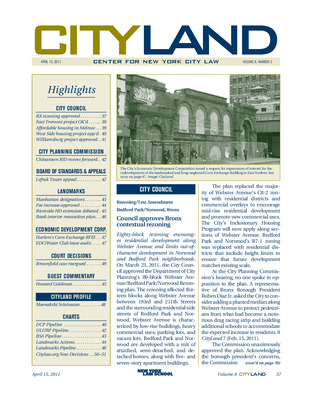
This issue of CityLand highlights major land use and zoning developments across New York City as of April 15, 2011. The City Council approved several affordable housing projects, including Courtlandt Crescent in Melrose, Clinton Commons in Manhattan, and developments in East Tremont and South Williamsburg. The Webster Avenue/Bedford Park/Norwood rezoning plan was adopted to encourage contextual residential growth and commercial revitalization in the Bronx. The City Planning Commission approved the creation of a large Chinatown Business Improvement District encompassing over 6,000 businesses. Landmark designations included the Japan Society Headquarters, Engineers’ Club Building, and the Neighborhood Playhouse. The Landmarks Preservation Commission also approved a fee increase for building permits and held hearings on the Riverside–West End Historic District Extension. The Economic Development Corporation issued a Request for Expressions of Interest for the redevelopment of the long-neglected Corn Exchange Building in East Harlem. A court ordered the NYS Department of Environmental Conservation to admit a Fort Greene site into the Brownfield Cleanup Program. A profile of Meenakshi Srinivasan, Chair of the Board of Standards and Appeals, explores her approach to transparency, consistency, and community engagement in land use decisions.
-
CityLand – Vol. 8, No. 2
Center for New York City Law
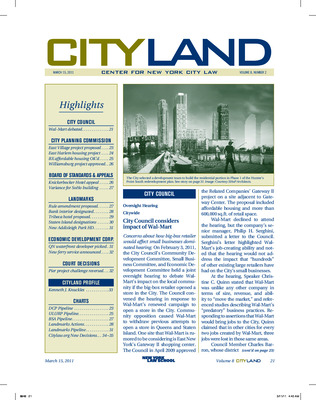
This issue of CityLand covers major land use and development initiatives in New York City as of March 15, 2011. The City Council held a contentious oversight hearing on Wal-Mart’s potential entry into the NYC market, raising concerns about its impact on small businesses. The City Planning Commission approved several affordable housing projects, including developments in East Harlem, the East Village, and the Bronx’s Melrose neighborhood. A mixed-use rezoning in Williamsburg advanced despite community opposition. The Board of Standards & Appeals granted a variance for the Knickerbocker Hotel’s conversion back to hospitality use and approved expanded commercial use for a narrow SoHo building. Landmarks designated the interior of the Manufacturers Trust Company Building and proposed rule changes to streamline staff-level approvals. New historic designations included four buildings in Staten Island’s Sandy Ground community and the Addisleigh Park Historic District in Queens. The Economic Development Corporation selected developers for Phase I of the Hunter’s Point South waterfront redevelopment and awarded a contract for expanded East River ferry service. A court decision upheld the environmental review for the renovation of Piers 92 and 94 in Manhattan. The issue also features a profile of Kenneth J. Knuckles, Vice Chair of the City Planning Commission.
-
CityLand – Vol. 8, No. 1
Center for New York City Law
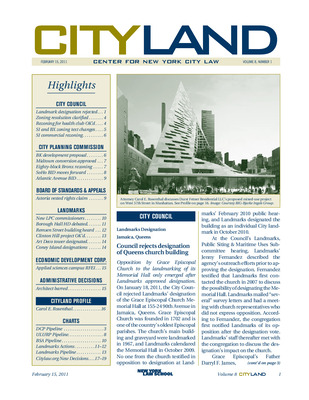
This issue of CityLand covers key land use and zoning developments in New York City as of February 15, 2011. Highlights include the City Council’s rejection of the landmark designation for Grace Episcopal Church Memorial Hall in Queens, citing community opposition and procedural concerns. The Council approved multiple zoning text amendments, including clarifications to the definitions of “development” and “building,” and modifications to the Lower Density Growth Management Area (LDGMA) regulations affecting Staten Island and the Bronx. Rezoning efforts in Bayside, Williamsburg, and Midtown South advanced mixed-use and affordable housing projects. The issue also reports on the creation of new Business Improvement Districts in SoHo and Atlantic Avenue, and the designation of several historic buildings including the 500 Fifth Avenue Art Deco skyscraper and iconic Coney Island structures. A profile of land use attorney Carol E. Rosenthal explores her work on major development projects and her insights into evolving trends in city planning and sustainability.
Printing is not supported at the primary Gallery Thumbnail page. Please first navigate to a specific Image before printing.