
-
CityLand – Vol. 9, No. 10
Center for New York City Law
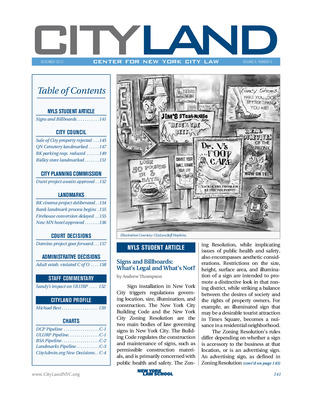
This issue of CityLand explores legal, planning, and preservation developments in New York City as of December 2012. It features a student article on the legal distinctions between accessory and advertising signs, and the regulatory frameworks governing signage in residential, commercial, and manufacturing districts. The City Council rejected the sale of 22 Reade Street to preserve its potential use for an African Burial Ground Museum, while approving the sale of 49–51 Chambers Street. The Brinckerhoff Cemetery in Queens was designated a landmark despite opposition from the property owner. The Council also approved reduced parking requirements for Downtown Brooklyn to encourage affordable housing. The Ridley & Sons Department Store buildings were designated as individual landmarks. Durst Development’s mixed-use project on the Hudson River re-entered ULURP, facing scrutiny over affordable housing provisions. Landmark hearings included proposals for the Brooklyn Heights Cinema redevelopment, the Marine Midland Bank building, and the conversion of a Harlem firehouse into a cultural center. The issue also covers the approval of a 23-story hotel on Fifth Avenue, the Domino Sugar project’s survival of a legal challenge, and an ECB decision regarding illegal adult establishment use. A profile of Michael Best, Counselor to Mayor Bloomberg, highlights his role during Hurricane Sandy.
-
CityLand – Vol. 9, No. 9
Center for New York City Law
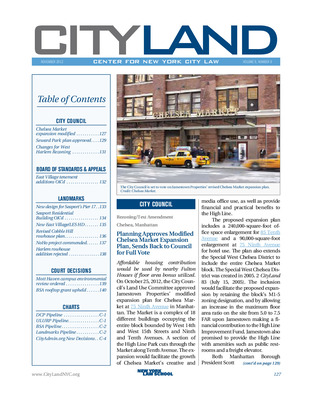
This issue of CityLand covers significant land use, zoning, and preservation developments in New York City as of November 2012. Key highlights include the City Council’s approval of Jamestown Properties’ modified Chelsea Market expansion plan, which includes contributions to affordable housing and the High Line. The Seward Park Mixed-Use Development Project was approved with increased housing units and space for a public school. The West Harlem rezoning plan was modified to address community concerns, including preservation of affordable housing. The Board of Standards & Appeals approved rooftop additions to East Village tenements despite opposition. Landmark Preservation Commission approved revised plans for Pier 17 and a narrow residential building in the South Street Seaport Historic District, and designated the East Village/Lower East Side Historic District. The issue also includes a commentary on Con Edison’s response to Hurricane Sandy and a court decision requiring supplemental environmental review for the Mott Haven school campus. Additional coverage includes zoning pipelines, BSA filings, and landmark approvals.
-
CityLand – Vol. 9, No. 8
Center for New York City Law
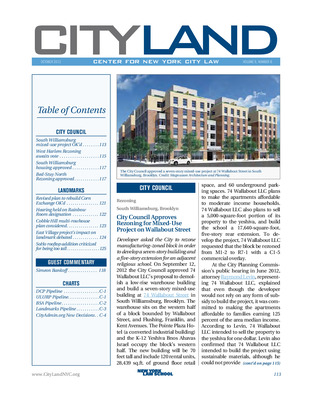
This issue of CityLand covers major land use and preservation developments in New York City as of October 2012. The City Council approved rezoning proposals for mixed-use and residential developments in South Williamsburg and Bedford-Stuyvesant North, and considered a 90-block rezoning in West Harlem. Landmarks approved a revised plan to restore Harlem’s Corn Exchange Building and held a public hearing on the Rainbow Room’s interior landmark designation. A multi-rowhouse restoration and construction plan in Cobble Hill was reviewed, and a nine-story development adjacent to the Merchant’s House Museum raised concerns about structural impacts. A proposed rooftop addition in SoHo was criticized for its scale and visibility. Guest commentary by Simeon Bankoff of the Historic Districts Council opposed proposed City Council legislation that would impose strict timelines and economic criteria on the landmark designation process, arguing it would undermine the Landmarks Preservation Commission’s mission and effectiveness.
-
CityLand – Vol. 9, No. 7
Center for New York City Law
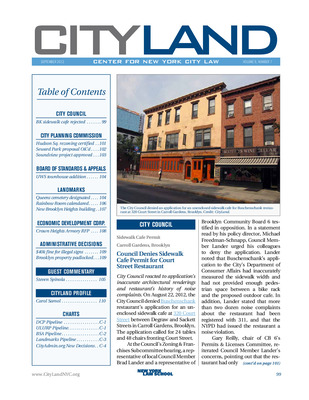
This issue of CityLand covers key land use and preservation developments in New York City as of September 2012. The City Council denied a sidewalk café permit for Buschenschank restaurant in Carroll Gardens due to inaccurate plans and noise complaints. The City Planning Commission certified Trinity Church’s proposal to create the Special Hudson Square District, and approved the Seward Park Mixed-Use Development Project and NYCHA’s Soundview affordable housing plan. BSA approved a rooftop addition to a townhouse on West 78th Street. Landmarks designated the Brinckerhoff Cemetery in Queens and calendared the Rainbow Room for interior landmark status. A new building and carriage house were approved for 437 Henry Street in Cobble Hill. EDC issued an RFP for reuse of the Bedford–Atlantic Armory drill hall. ECB upheld $40,000 in fines for illegal signage on a Brooklyn bodega, and Buildings padlocked a Gravesend property used for commercial purposes. Guest commentary by Steven Spinola of REBNY called for reforms to the landmark designation process. City Planning’s Carol Samol was profiled for her work in Bronx redevelopment and ULURP pre-certification reform.
-
CityLand – Vol. 9, No. 6
Center for New York City Law
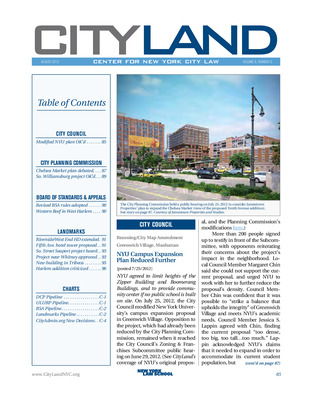
This issue of CityLand covers major land use and preservation developments in New York City as of August 2012. The City Council approved a further-reduced version of NYU’s Core Expansion Plan, including height reductions and community space commitments. The City Planning Commission held a hearing on Jamestown Properties’ Chelsea Market expansion, which faced opposition over its impact on the High Line and lack of affordable housing. A rezoning in South Williamsburg was approved to facilitate a two-building residential project with affordable units. The Board of Standards & Appeals adopted revised rules to streamline application procedures and approved a special permit for a Western Beef supermarket in Harlem. Landmarks designated the Riverside Drive–West End Historic District Extension I and considered a 23-story hotel tower near the Plaza Hotel. Projects in the South Street Seaport and Upper East Side (adjacent to the Whitney Museum) were reviewed, with the latter approved after multiple revisions. A nine-story residential building in Tribeca was approved following design changes, while a proposed rooftop addition in Harlem was sent back for redesign. The issue also includes charts on ULURP, BSA, and Landmarks activity.
-
CityLand – Vol. 9, No. 5
Center for New York City Law
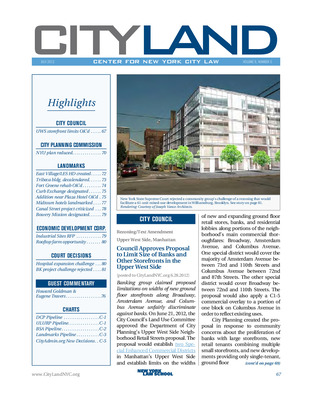
This issue of CityLand covers major land use and preservation developments in New York City as of July 2012. The City Council approved a zoning text amendment to limit the size of banks and storefronts in the Upper West Side’s commercial corridors. The City Planning Commission modified and approved NYU’s Core Expansion Plan, reducing building heights, eliminating a proposed hotel, and requiring oversight of open space. Landmarks held a hearing on the proposed East Village/Lower East Side Historic District, receiving mixed testimony. A heavily altered Federal-era rowhouse at 177 West Broadway was decalendared. Landmarks approved reconstruction of a deteriorated Fort Greene townhouse and designated the New York Curb Exchange and Bowery Mission as individual landmarks. Two Midtown hotels—the Hotel Mansfield and Martha Washington Hotel—were also designated. A proposed building at 341 Canal Street was criticized for lacking architectural quality. Guest commentary by Howard Goldman and Eugene Travers discussed proposed City Council reforms to the Landmarks Law. EDC issued RFPs for industrial sites in the Bronx, Brooklyn, and Queens, and for a rooftop farm in Hunts Point. Courts dismissed challenges to a hospital expansion in Bayside and a mixed-use development in Williamsburg, affirming the City’s land use decisions.
-
CityLand – Vol. 9, No. 4
Center for New York City Law
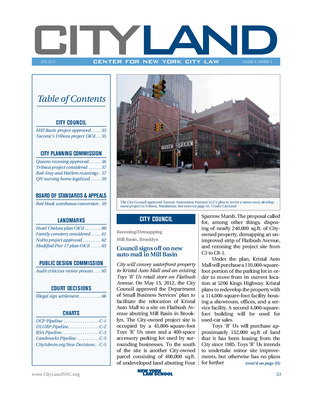
This issue of CityLand covers significant land use and preservation developments in New York City as of June 2012. The City Council approved the Mill Basin rezoning and land disposition plan, facilitating Kristal Auto Mall’s relocation and Toys ‘R’ Us site improvements. Taconic Investment Partners received approval to revive a seven-story residential project in Tribeca. The City Planning Commission approved a large contextual rezoning for Woodhaven and Richmond Hill, and certified major rezonings for Bedford-Stuyvesant North and West Harlem. A special permit was considered for a nine-story building at 83 Walker Street in Tribeca. The Commission also reviewed a retroactive special permit for a completed nursing home in Briarwood, Queens. BSA granted an extension for a Red Hook warehouse conversion after a lengthy legal battle. Landmarks approved the Chetrit Group’s revised plan for the Hotel Chelsea, including façade restoration and a rooftop lounge. The Brinkerhoff Cemetery in Queens was considered for designation amid strong community support. A revised seven-story building design at Bond and Lafayette Streets in NoHo was approved. Landmarks issued a binding report for the redevelopment of Pier 17 in the South Street Seaport Historic District. A City Comptroller audit criticized the Public Design Commission’s review process. A record $225,000 settlement was reached for illegal signage on a landmarked building in SoHo.
-
CityLand – Vol. 9, No. 3
Center for New York City Law
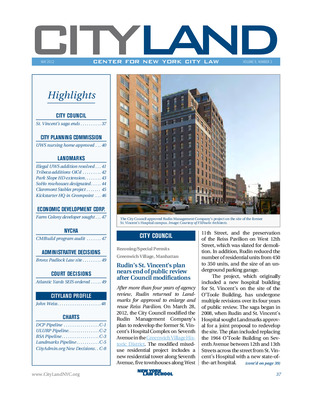
This issue of CityLand covers major land use and preservation developments in New York City as of May 2012. The City Council approved Rudin Management’s redevelopment of the former St. Vincent’s Hospital campus in Greenwich Village, including preservation of the Reiss Pavilion and creation of an AIDS memorial park. The City Planning Commission certified Jewish Home Lifecare’s proposal for a new nursing home on West 97th Street, despite community concerns about land scarcity. Landmarks resolved a long-standing conflict over an illegal addition on West 68th Street and approved revised additions to two buildings on Lispenard Street in Tribeca. The Park Slope Historic District Extension was designated, adding 600 buildings to Landmarks’ jurisdiction. Three Federal-era rowhouses on Dominick Street were landmarked, while a fourth was excluded due to loss of historic fabric. The Stephen Gaynor School received approval for a rooftop addition to the Claremont Stables. Kickstarter won approval to adaptively reuse a Greenpoint building for its headquarters. EDC issued an RFEI for redevelopment of the Farm Colony site in Staten Island. A City Comptroller audit criticized NYCHA’s oversight of its CM/Build program. Landmark’s Deputy Counsel John Weiss was profiled for his work combating demolition-by-neglect. A court ordered ESDC to conduct a supplemental environmental review of the Atlantic Yards project due to extended build-out timelines.
-
CityLand – Vol. 9, No. 2
Center for New York City Law
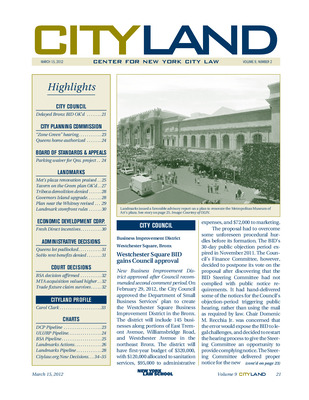
This issue of CityLand covers key land use and zoning developments in New York City as of March 15, 2012. The City Council approved the creation of the Westchester Square BID in the Bronx after resolving procedural notice issues. The City Planning Commission held a hearing on the “Zone Green” zoning text amendment to promote energy-efficient retrofits and green building design. A residential development was authorized in a manufacturing district in Ridgewood, Queens. BSA approved reduced parking requirements for a medical facility in Brooklyn despite community opposition. Landmark approvals included the Metropolitan Museum of Art’s plaza renovation and the restoration of Tavern on the Green. A proposal to demolish a historic Tribeca facade was denied, and Governors Island’s redevelopment plan received approval for signage and landscaping. A revised plan for development near the Whitney Museum was presented. Landmarks proposed new citywide storefront rules to streamline approvals. Fresh Direct received an $81 million incentive package to relocate to the Bronx, sparking debate over labor practices and environmental impact. Administrative decisions addressed padlock law enforcement and loft law protections. Court decisions upheld BSA’s hotel extension in Dutch Kills, increased compensation for MTA acquisitions in Sunnyside, and allowed trade fixture claims in Lower Manhattan. A profile of Carol Clark highlights her work at HPD and her commitment to affordable housing and historic preservation.
-
CityLand – Vol. 9, No. 1
Center for New York City Law
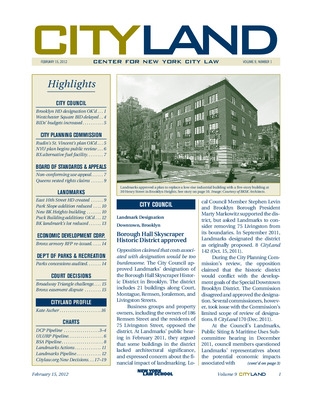
This issue of CityLand covers significant land use and zoning developments in New York City as of February 15, 2012. The City Council approved the designation of the Borough Hall Skyscraper Historic District in Downtown Brooklyn, despite opposition from property owners concerned about economic impacts. The Westchester Square BID re-entered its objection period due to notice delivery issues, and six BIDs across the city received budget increases. The City Planning Commission approved Rudin Management’s redevelopment plan for the former St. Vincent’s Hospital site and certified NYU’s long-term campus expansion proposal in Greenwich Village. A public alternative fueling station was approved for Hunts Point, Bronx. Landmark designations included the East 10th Street Historic District and the Brooklyn Union Gas Company Building. Rooftop additions were approved for the Puck Building and a Park Slope townhouse after revisions. The Coignet Building’s landmark boundaries were reduced to accommodate Whole Foods development. The Economic Development Corporation reissued an RFP for the Kingsbridge Armory, emphasizing living wage provisions. Court decisions addressed housing discrimination in the Broadway Triangle redevelopment and public access rights to a Bronx beach. A profile of Kate Ascher explores her work on urban infrastructure and parkland planning around Jamaica Bay.
Printing is not supported at the primary Gallery Thumbnail page. Please first navigate to a specific Image before printing.