
-
CityLand – Vol. 7, No. 11
Center for New York City Law
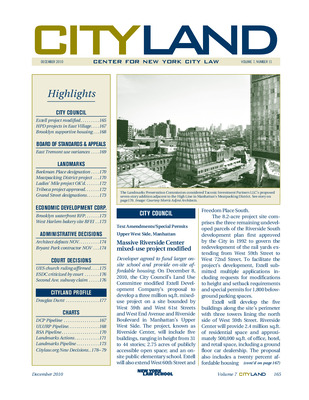
The December 2010 issue of CityLand highlights significant land use, zoning, and preservation developments across New York City. The City Council modified Extell’s Riverside Center proposal on the Upper West Side, increasing on-site affordable housing and school space. Supportive housing projects were approved in the East Village and Prospect Lefferts Gardens, with community concerns addressed through design revisions. The Board of Standards & Appeals granted variances for a three-building affordable housing project in East Tremont, Bronx, citing site constraints from an abandoned railway. Landmarks designated Paul Rudolph’s penthouse at 23 Beekman Place and two Federal-era rowhouses on Grand Street, while approving additions in the Meatpacking District, Ladies’ Mile, and Tribeca. The Economic Development Corporation issued RFPs and RFEIs for redevelopment of the Bush Terminal waterfront site in Sunset Park and the Taystee Bakery complex in West Harlem. Court decisions included a ruling affirming a church’s right to host catered events and criticism of ESDC’s environmental review process for the Atlantic Yards project. The issue concludes with a profile of Douglas Durst, discussing sustainable development, green building leadership, and the One World Trade Center project.
-
CityLand – Vol. 7, No. 10
Center for New York City Law
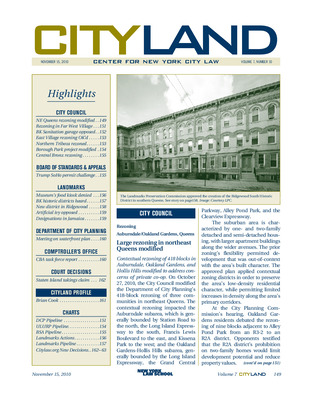
The November 2010 issue of CityLand covers major land use, zoning, and preservation developments across New York City. The City Council approved modified rezonings in Auburndale, Oakland Gardens, and Hollis Hills in Queens, and contextual rezonings in the Far West Village, East Village, North Tribeca, and Central Bronx. The Culver El housing project in Borough Park was modified to retain manufacturing zoning and extend affordability terms. The Department of Sanitation withdrew a controversial garage lease proposal in East Williamsburg. The Board of Standards & Appeals upheld the Trump SoHo permit, rejecting a community challenge over floor area calculations. Landmarks designated the Ridgewood South Historic District and several individual landmarks in Jamaica, Queens, while rejecting a proposed food kiosk at the Guggenheim Museum. Hearings were held for new historic districts in Park Slope, Wallabout, and Crown Heights. The Department of City Planning presented its Vision 2020 waterfront plan, and the Comptroller’s Office released a task force report proposing a framework for Community Benefit Agreements. The issue concludes with a profile of Brian Cook, Director of Land Use for Manhattan Borough President Scott Stringer, discussing community empowerment and comprehensive planning.
-
CityLand – Vol. 7, No. 9
Center for New York City Law
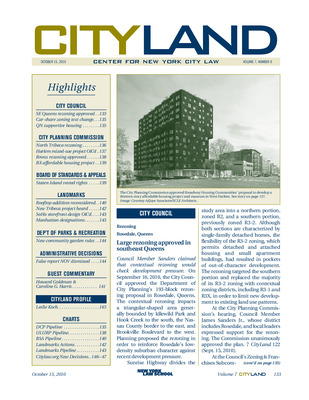
The October 2010 issue of CityLand covers major land use and preservation developments across New York City. The City Council approved the large-scale rezoning of Rosedale in Queens to preserve its low-density character, and adopted the CarShare Text Amendment to regulate off-street parking for car-share vehicles. Hour Children’s affordable housing project for formerly incarcerated women in Ravenswood was approved. The City Planning Commission advanced rezonings in North Tribeca, West Harlem (Sugar Hill), and East Tremont in the Bronx, all aimed at promoting mixed-use development and affordable housing. The Board of Standards & Appeals granted vested rights to a Staten Island developer who had nearly completed foundations before a rezoning took effect. Landmarks reviewed a revised rooftop addition for a Ladies’ Mile building and considered a new residential project in Tribeca. Three Manhattan buildings were designated as individual landmarks: the 97 Bowery Building, Loew’s Canal Street Theatre, and the Eleventh Street Methodist Episcopal Chapel. The Department of Parks and Recreation released new rules to preserve community gardens, and the issue concludes with a profile of Leslie Koch, president of The Trust for Governors Island, discussing redevelopment plans and tenant outreach.
-
CityLand – Vol. 7, No. 8
Center for New York City Law
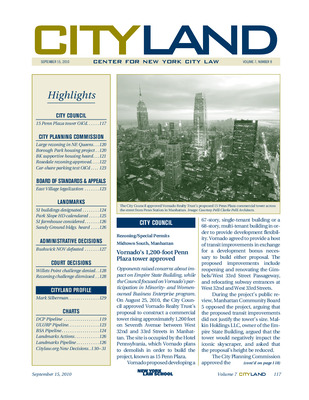
The September 2010 issue of CityLand covers significant land use, zoning, and preservation developments across New York City. The City Council approved Vornado Realty Trust’s 15 Penn Plaza commercial tower, despite concerns about its impact on the Empire State Building and MWBE participation. The City Planning Commission approved large rezonings in northeast Queens (Auburndale, Oakland Gardens, Hollis Hills) and Rosedale, as well as the Culver El rezoning and housing project in Borough Park. A supportive housing project for women in Prospect Lefferts Gardens was debated. The Commission also approved a zoning text amendment regulating car-share parking. The Board of Standards & Appeals ruled on a controversial East Village building addition and legalized artist studios in Bushwick. Landmarks designated Staten Island’s Christ Church complex and the 51st Cavalry Brigade Armory, and calendared an extension of the Park Slope Historic District. Hearings were held on historic buildings in Sandy Ground and the Lakeman House. The issue concludes with a profile of Mark Silberman, General Counsel of the Landmarks Preservation Commission, highlighting his legal and policy contributions to preservation in New York City.
-
CityLand – Vol. 7, No. 7
Center for New York City Law
The August 2010 issue of CityLand covers major land use, zoning, and preservation developments across New York City. The City Council approved the Flushing Commons and Macedonia Plaza projects in Queens, following a $6 million commitment to support small businesses during construction. The Council also approved the redevelopment of the Domino Sugar site in Williamsburg and advanced the acquisition of the final section of the High Line. The City Planning Commission approved the 15 Penn Plaza commercial tower proposal, which includes reopening the historic Gimbels Passageway. The issue reports on a proposed zoning text amendment to regulate car-share parking and several Board of Standards & Appeals decisions, including a controversial sliver tower on the Upper West Side. Landmarks actions include the designation of the Look Building and the decalendaring of 45 Park Place, the proposed site of the Park51 mosque. The issue concludes with a profile of Amanda M. Burden, highlighting her leadership on the Vision 2020 waterfront plan.
-
CityLand – Vol. 7, No. 6
Center for New York City Law
The July 2010 issue of CityLand covers significant land use, zoning, and preservation developments across New York City. Highlights include the City Council’s approval of a modified version of the Domino Sugar redevelopment in Williamsburg, restoring the height of the office tower and adjusting other components. The Council also approved a zoning text amendment to facilitate a 22-story affordable housing project in West Chelsea and a rezoning for a mixed-income development in Crotona Park East, Bronx. Additional approvals included a new public school facility for P.S. 51 in Clinton and a thirteen-story mixed-use building near Fordham University. The City Planning Commission approved the Flushing Commons and Macedonia Plaza projects, and certified rezonings for Rosedale, North Tribeca, and the West Village. Landmarks designated the Greenwich Village Historic District Extension II and held hearings on the Grand Concourse Historic District and twelve individual buildings, including the Japan Society and Loew’s Canal Street Theatre. Legal decisions included the Court of Appeals’ reversal of a lower court ruling, upholding Columbia University’s use of eminent domain for its West Harlem expansion. A profile of Council Member Leroy Comrie explores his leadership as Chair of the Land Use Committee.
-
CityLand – Vol. 7, No. 5
Center for New York City Law
The June 2010 issue of CityLand covers major land use, zoning, and preservation developments across New York City. Highlights include the City Council’s approval of the landmark designation for the West Park Presbyterian Church on the Upper West Side, despite opposition from the congregation. The Council also approved a comprehensive rezoning of 238 blocks in Astoria, Queens, while rejecting a proposed commercial overlay for a bank development in Borough Park, Brooklyn. The City Planning Commission reviewed the Flushing Commons proposal—a large mixed-use development replacing a municipal parking lot—and certified rezonings for northeast Queens, the Bronx’s Third Avenue corridor, and Manhattan’s East Village. Landmarks designated the SoHo–Cast Iron Historic District Extension and the William Ulmer Brewery in Bushwick. Certificates of Appropriateness were issued for new buildings and façade alterations in NoHo and the Upper East Side. The issue also reports on the City’s acquisition of the High Line’s northern section, updates to the CEQR Technical Manual, and the launch of a local brownfield cleanup grant program. Legal decisions include the dismissal of a challenge to the Coney Island rezoning and a ruling overturning the State’s denial of brownfield benefits for a contaminated site in Fort Greene. A profile of land use attorney Michael T. Sillerman explores his views on zoning, historic districts, and the ULURP process.
-
CityLand – Vol. 7, No. 4
Center for New York City Law
The May 2010 issue of CityLand covers major land use and zoning developments across New York City. Highlights include the City Council’s approval of the Rose Plaza on the River project in Williamsburg, which increased affordable housing to 30% of units. The City Planning Commission reviewed the proposed redevelopment of the Domino Sugar site, raising concerns about infrastructure and affordability. A zoning text amendment was introduced to regulate car-share vehicle parking citywide. The Council approved Knickerbocker Commons, a Bushwick apartment building designed to meet Passive House energy standards. Staten Island’s Grymes Hill and Sunnyside neighborhoods were rezoned to preserve low-density character and hillside topography. Landmark designations included the Springs Mills Building in Midtown Manhattan, and several Certificates of Appropriateness were issued for projects in historic districts. The issue also reports on the City’s acquisition of Governors Island and its redevelopment master plan, along with legal decisions upholding emergency demolitions and dismissing rezoning challenges. A profile of Council Member Mark Weprin explores his approach to land use and community engagement.
-
CityLand – Vol. 7, No. 3
Center for New York City Law
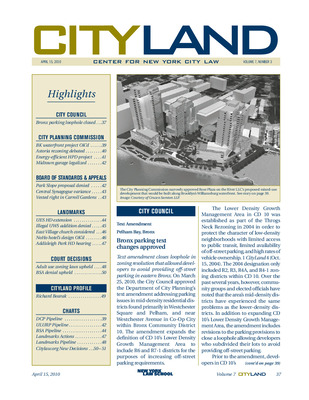
The April 2010 issue of CityLand covers significant land use, preservation, and legal developments in New York City. The City Council approved a zoning text amendment to close a parking loophole in Bronx Community District 10. The City Planning Commission approved the controversial Rose Plaza on the River development in Williamsburg and held hearings on the Astoria contextual rezoning and an energy-efficient affordable housing project in Bushwick. BSA denied a variance for additional townhouses in Park Slope and granted variances for Central Synagogue and a Carroll Gardens development. Landmark actions included the designation of the Upper East Side Historic District Extension, the Brill Building, and the Bissell House. Landmarks also denied legalization of an unauthorized rooftop addition on West 68th Street and approved the design for a partially-built hotel in NoHo. Hearings were held for the Olivet Memorial Church and Addisleigh Park Historic District. Legal updates include court rulings upholding adult use zoning laws and BSA’s denial of a special permit. The issue concludes with a profile of Richard Bearak, Director of Land Use for Brooklyn Borough President Marty Markowitz.
-
CityLand – Vol. 7, No. 2
Center for New York City Law
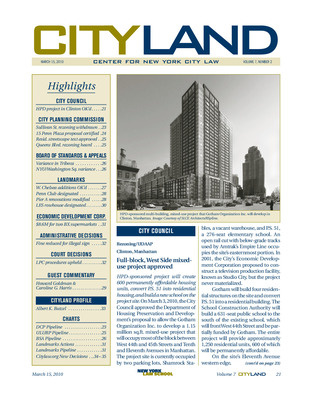
The March 2010 issue of CityLand covers major land use and preservation developments in New York City. The City Council approved Gotham Organization’s mixed-use development in Clinton, Manhattan, which includes 600 affordable units and a new school. The City Planning Commission rejected a proposed commercial overlay extension on Sullivan Street and certified Vornado Realty Trust’s 15 Penn Plaza office tower proposal. The Commission also approved a citywide Residential Streetscape Preservation text amendment and heard testimony on a rezoning proposal for Queens Boulevard. BSA granted variances for NYU’s Center for Academic and Spiritual Life and a Tribeca residential building. Landmark actions included approvals for rooftop additions in West Chelsea, designation of the Penn Club, and modifications to Pier A’s renovation plan. The 143 Allen Street House was designated a landmark. The NYC Industrial Development Agency awarded $8.6 million in tax incentives to two Bronx supermarkets under the FRESH program. Legal updates include a reduced fine for illegal signage and a court ruling upholding LPC’s designation procedures. The issue concludes with a profile of land use attorney and activist Albert K. Butzel.
-
CityLand – Vol. 7, No. 1
Center for New York City Law
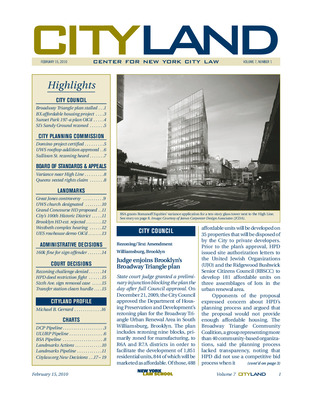
The February 2010 issue of CityLand covers significant land use, preservation, and legal developments in New York City. A judge enjoined the Broadway Triangle rezoning plan following its approval by the City Council. The Council also approved a 393-unit affordable housing project in the Bronx and adopted the Sunset Park 197-a Plan. Staten Island’s Sandy Ground neighborhood was downzoned to preserve its historic character. The City Planning Commission certified the massive Domino Sugar redevelopment proposal and approved a rooftop addition in the Upper West Side. A proposed commercial overlay extension on Sullivan Street raised concerns about neighborhood character. BSA granted a variance for a High Line-adjacent office tower and vested rights for two Queens buildings. Landmark actions included the designation of West Park Presbyterian Church and the Perry Avenue Historic District, the City’s 100th. Landmarks declined to extend the Ocean on the Park Historic District. Legal updates include a $160,000 fine for billboard violations, a court ruling upholding the East Village rezoning, and litigation over HPD deed restrictions and sign removal. The issue concludes with a profile of Michael B. Gerrard, Director of Columbia Law School’s Center for Climate Change Law.
Printing is not supported at the primary Gallery Thumbnail page. Please first navigate to a specific Image before printing.